Article
Stop Motivating Your Employees
• Motivation, Leadership, Intrinsic motivation
-f58c1330.jpg)
Matthias Orgler, M.Sc.
Engineer, founder, and organizational advisor

You want to motivate your employees. Of course you do. You’re their leader. That’s your job.
You take that responsibility seriously. When people seem disengaged, you ask yourself how to get them involved. You want them to contribute ideas, take responsibility, and find satisfaction in their work. If you could help them become more motivated, everyone would benefit.
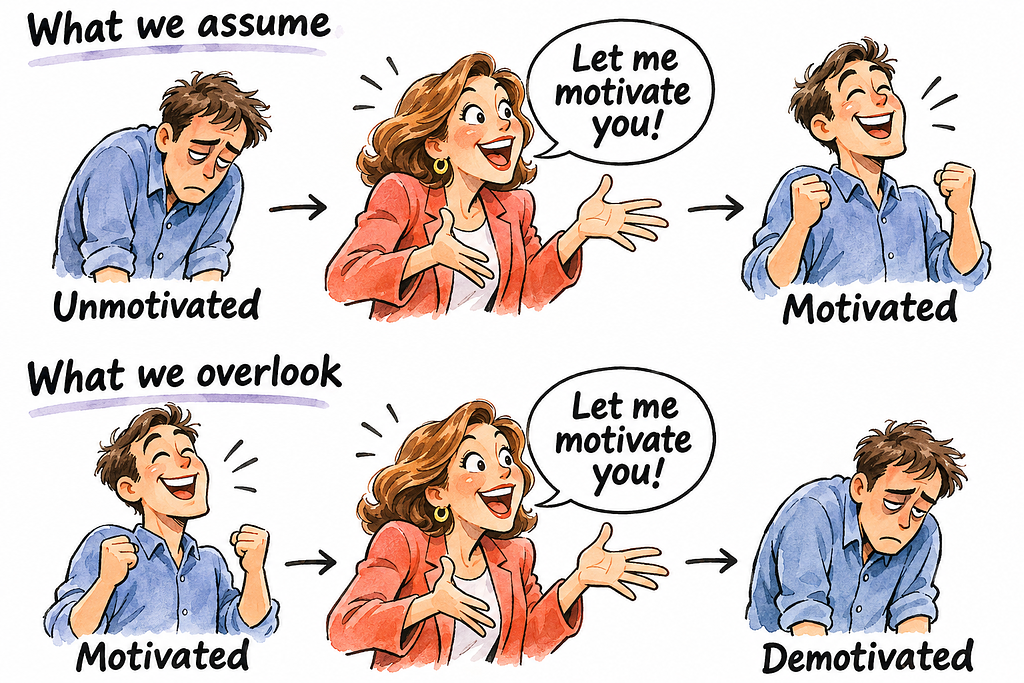
There’s an unspoken assumption in that job description: employees arrive unmotivated. Your work turns them into motivated employees. You supply what they lack. Their motivation is your achievement.
You probably wouldn’t describe your colleagues as unmotivated raw material. Yet that is the starting point of the task you’ve accepted.
Now turn it around. The employee arrives motivated. You set about motivating them. The result is a demotivated employee.
That might sound like a provocative thought experiment. But research shows that rewards and control can undermine people’s existing motivation. We’ll look at how this happens. For now, consider what it means for the job you thought you were doing: the lack of motivation you’re trying to fix could be something your motivational efforts helped create.
You would be solving the wrong problem. Worse, you could be prescribing more of what caused it.
If you assume people lack motivation, you look for ways to add it. But if you recognize that something is demotivating them, you look for what needs to stop. The way you define the problem determines where you look for a solution.
And while you’re searching for a better way to motivate your employees, you might never consider leaving their motivation alone.
You inherited the assignment
You don’t have to consciously believe that people avoid work. You only have to accept that motivating them belongs to your role.
And why wouldn’t you? Your managers did it. Leadership courses taught it. Job descriptions asked for it. By the time you became responsible for a team, motivating employees sounded about as questionable as organizing meetings.
So you ask how to do it well. You compare techniques, read advice, and reflect on your performance. All sensible activities, provided the assignment itself makes sense.
But that is the part you haven’t examined.
You can be thoughtful about your methods while taking their underlying assumption entirely for granted. And because you care about your team, disappointing results may encourage you to try even harder.
Their lack of motivation becomes evidence that they need more of your motivational attention.
That is how a conscientious leader can keep a bad diagnosis alive.
When the reward becomes the reason
In Mythos Motivation, Reinhard K. Sprenger makes the provocation explicit: “Alles Motivieren ist Demotivieren.” Every attempt to motivate demotivates. [1]
He distinguishes people’s own motivation from Motivierung: attempts to produce the desired willingness through external inducements. You want people to care, so you give them something to care about if they comply.
But in doing so, you can change their reason for acting.
Imagine someone who enjoys helping colleagues solve difficult problems. Then management introduces a scheme that rewards employees for recorded contributions. Suddenly, helping has a second purpose: getting credit.
An undocumented conversation helps the colleague just as much as before. But now it earns nothing.
When someone eventually asks, “Does this count toward my target?”, management may complain that people have become transactional.
But you introduced the transaction.
Research supports taking this risk seriously. In a meta-analysis of 128 experiments, Deci, Koestner, and Ryan found that several forms of expected tangible reward reduced subsequent voluntary engagement with activities. People became less willing to continue once the reward was no longer available. [2]
The lesson is uncomfortable because the intervention can appear successful at first. People do what you reward. But that immediate response can conceal a change in what makes the activity worth doing.
So you may conclude that the reward is necessary precisely because people have learned to expect it.
The numbers can improve while the problem gets worse
None of this requires pretending that incentives never work. They can increase performance. A later meta-analysis found that incentives better predicted performance quantity, while intrinsic motivation better predicted quality. Both could contribute. [3]
But producing more of a measured result and caring more about the work are different achievements.
If you reward closing support tickets, people have a reason to close tickets. Whether customers actually get their problems solved is another question. And if a difficult case threatens someone’s numbers, the incentive may discourage precisely the care you wanted.
The employee doesn’t have to misunderstand your scheme for this to happen. They may understand it perfectly.
You asked for commitment to the work. But you paid for commitment to the measure.
That is why “it works” needs a more demanding follow-up: what, exactly, is working?
You may be getting the behavior you specified while losing the judgment you forgot to specify. And no incentive scheme can anticipate every useful contribution people might make.
What happened when they tried?
Rewards aren’t the only interventions worth examining. You also need to look at what happens to people’s efforts before you decide they need an attitude adjustment.
Imagine a developer who wants to understand the customer’s problem. She asks to join a customer conversation, but customer contact belongs to another department.
She proposes fixing a recurring defect, but the quarterly feature plan takes priority. She raises a concern about a release date, but that commitment has already been made.
Eventually, she stops suggesting things and concentrates on her assigned tickets.
Then her manager asks her to show more initiative.
The organization has spent months teaching her what happens to initiative. Now it complains that she learned.
A motivational workshop is unlikely to change that lesson if the restrictions remain. It may simply give her another reason to doubt that management understands her work.
But if you define her withdrawal as a shortage of motivation, a workshop can seem entirely reasonable. The diagnosis directs your attention toward her willingness and away from her experience.
So before asking how to make her care, ask what happened when she cared.
Stop making good work harder
People bring different motives to work. They may want to learn, solve problems, earn a living, support colleagues, or do something useful. Those motives won’t automatically match every assignment, and nobody enjoys every task.
But that doesn’t make people empty containers waiting for managerial enthusiasm.
Self-determination theory describes how social conditions can support or undermine self-motivation. It identifies autonomy, competence, and relatedness as basic psychological needs: having a meaningful say, feeling capable, and experiencing connection with others. [4]
For a leader, that creates substantial work. You may need to clarify a purpose, resolve conflicting priorities, provide training, or give people the authority their responsibilities require.
And sometimes you need to stop doing something.
If people regain enthusiasm after you remove an absurd approval process, you might say you motivated them. But they may offer a simpler explanation: you finally removed the absurd approval process.
They had been asking for months.
That is what I mean when I say in workshops: you cannot motivate people. You can remove demotivators. You can stop demotivating them.
The distinction changes your next move. Instead of searching for a technique to increase willingness, you investigate what makes willingness difficult to sustain.
Start by asking what people have stopped suggesting. Then listen to why. If you immediately explain why every restriction is necessary, you may discover why they stopped telling you.
And when you identify an obstacle, change something. Let the developer join the customer conversation. Resolve the competing priorities. Give the team a decision you currently require them to bring to you.
People can judge your commitment to improvement without attending a presentation about it.
Appreciation still belongs here
You can also recognize someone’s contribution, encourage them through a difficult task, and tell them why their work matters. The problem isn’t that leaders influence people. Of course they do.
The question is whether you are responding to a person’s contribution or using a technique to obtain the next one.
“Thank you for raising that concern. We caught something we would have missed” tells someone what you valued.
“That was excellent. I knew I could count on you. Now I need another favor” does something else.
Appreciation becomes suspicious when it regularly arrives carrying a request.
And it becomes insulting when it substitutes for fixing the conditions people are struggling with. Thanking a team for another weekend of emergency work may be appropriate. But if you keep creating the emergency, gratitude is becoming a remarkably cheap operating model.
Before you try harder
Some employees will lack the skills, interest, or willingness for a particular job. You still need clear expectations, honest conversations, and decisions about performance.
But “they need motivating” can spare you the trouble of finding out what is actually happening.
It can also spare you a less comfortable discovery: that your contribution to the problem deserves attention.
So before your next attempt to motivate the team, ask what you believe your intervention will supply. Then ask whether people once brought it themselves, and what their experience at work has done to it.
You may need to help them overcome a difficulty. But you may also need to stop being one.
Frequently asked questions
Should I stop praising people?
Tell people what you appreciated about their contribution. Be specific and sincere. But don’t turn every thank-you into a calculated attempt to secure more effort.
What about necessary work nobody enjoys?
Explain why it matters, share the burden fairly, and remove avoidable frustrations. People can willingly do something they don’t enjoy. They don’t need to pretend it is exciting.
What if removing demotivators doesn’t solve the problem?
Investigate further. Capability, workload, competing priorities, personal circumstances, and role fit may all matter. Removing demotivators gives you a better starting point; it doesn’t relieve anyone of responsibility.
Sources and further reading
- Reinhard K. Sprenger. Mythos Motivation: Wege aus einer Sackgasse. Campus. Publisher’s description.
- Deci, E. L., Koestner, R., & Ryan, R. M. (1999). A meta-analytic review of experiments examining the effects of extrinsic rewards on intrinsic motivation. Psychological Bulletin, 125(6), 627–668.
- Cerasoli, C. P., Nicklin, J. M., & Ford, M. T. (2014). Intrinsic motivation and extrinsic incentives jointly predict performance: A 40-year meta-analysis. Psychological Bulletin, 140(4), 980–1008.
- Ryan, R. M., & Deci, E. L. (2000). Self-determination theory and the facilitation of intrinsic motivation, social development, and well-being. American Psychologist, 55(1), 68–78.
- Falk, A., & Kosfeld, M. (2006). The hidden costs of control. American Economic Review, 96(5), 1611–1630. Further reading supporting the introduction’s reference to control; the article’s workplace examples are illustrative.