Article
AI Will Help You Build the Wrong Thing Faster
• AI, Leadership, Agile, Product Development, Organizational Learning, Innovation, Management
-f58c1330.jpg)
Matthias Orgler, M.Sc.
Engineer, founder, and organizational advisor

Right now, almost every company is trying to “do something with AI.”
AI copilots. AI-generated presentations. AI coding assistants. AI pilots everywhere. Executives are under pressure not to fall behind, and honestly, some of the tools are incredible. Teams can suddenly create mockups in hours instead of weeks. Developers generate code faster. Product managers crank out specifications at ridiculous speed. Marketing teams flood the internet with content.
Output explodes.
And yet a lot of companies quietly feel disappointed.
Projects still drag on. Products still miss the mark. Teams still build things customers do not want. Priorities still change too late. Meetings still eat everybody alive. The expected breakthrough somehow never comes.
A lot of companies thought AI would make them faster.
Instead, they just started producing wrong stuff faster.
That sounds harsh, but it explains why so many companies currently feel confused. They adopted AI. People are using it. Output increased. And yet the business impact often feels strangely small.
Why?
Because the real problem was never typing speed.
The real problem is that many companies still learn too slowly.
Companies Say They Want Feedback Until the Feedback Hurts
Most companies do not avoid feedback. They avoid the kind of feedback that could force them to change the plan.
That’s the important difference.
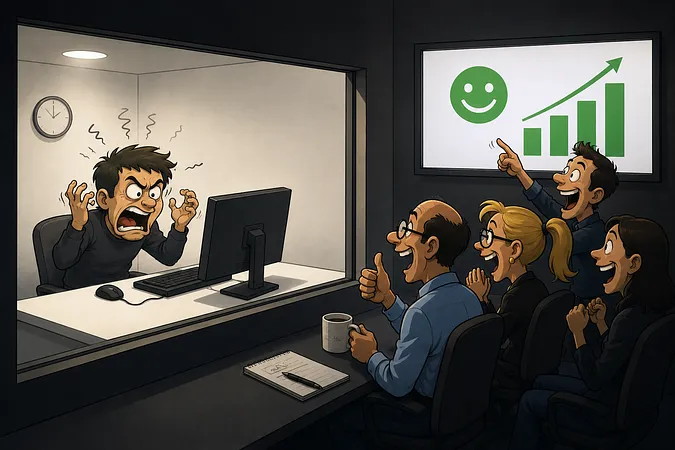
You can see this everywhere once you start paying attention. Teams avoid showing messy prototypes. Risky features get delayed until they “look better.” Customers only see polished demos. Sprint reviews become carefully scripted theater.
Instead of showing the actual product, teams show PowerPoint slides explaining how much progress was made.
And if users finally say:
“This workflow makes no sense.”
“This workflow makes no sense.”
The reaction often is not:
“Oh wow, good catch. We misunderstood something important.”
“Oh wow, good catch. We misunderstood something important.”
Instead it becomes:
- “Users just need training.”
- “This will make sense once everything is finished.”
- “We’ll explain it better in the manual.”
- “The customer misunderstood it.”
Companies say they want feedback until the feedback hurts.
Learning is welcome as long as it does not mess with the roadmap.
A Lot of “Agile” Is Just Smaller Reporting Cycles
Many companies proudly say:
“We work in sprints.”
“We iterate.”
“We’re Agile.”
“We work in sprints.”
“We iterate.”
“We’re Agile.”
But if you look closely, nothing important actually changes.
The roadmap stays the same. The assumptions stay the same. The priorities stay the same. The big decisions were already made months ago.
A lot of companies didn’t speed up learning. They just started reporting status every two weeks.
The sprint review became a fancy status meeting. Teams demo safe things. Stakeholders nod politely. Everybody pretends the roadmap still makes sense. Then everybody goes back to building.
If the plan never changes, the sprint was theater.
Real iteration means something uncomfortable happened. An assumption failed. A customer reacted differently than expected. A workflow turned out to be wrong. A feature nobody cared about got killed.
That is learning.
Everything else is just smaller reporting cycles.
The System Quietly Protects the Plan
This is where the real problem starts.
In many companies, nobody openly says:
“Don’t fail.”
“Don’t fail.”
Actually, many leaders say the exact opposite:
- “We want innovation.”
- “Experiment more.”
- “Challenge assumptions.”
- “We need honest feedback.”
But then the system quietly punishes people anyway.
Roadmap commitments. Annual budgeting. Performance reviews. Approval chains. Status reporting. Executive promises. Political pressure.
People quickly learn what is dangerous.
Don’t embarrass the sponsor. Don’t challenge the roadmap. Don’t raise concerns too early. Don’t be “negative.” Don’t slow things down.
So people adapt.
They stop showing risky work. They stop raising concerns. They stop challenging assumptions.
Smart people stop thinking when the system punishes thinking.
And over time, the organization slowly trains itself to protect the plan from reality.
That is the real bottleneck.
AI Makes This Problem Much More Expensive
Before AI, fake learning wasted months.
Now teams can generate huge amounts of work almost instantly. Code. Features. Reports. Mockups. Presentations. Documentation.
AI speeds up building.
It does not automatically speed up learning.
Studies from McKinsey and Deloitte show that many organizations are still struggling to scale AI successfully despite massive investment and experimentation.
That makes perfect sense.
If a company already avoids uncomfortable feedback, AI will not fix that. It will just help the company move faster before reality catches up.
The faster you can build, the more expensive fake learning becomes.
Imagine a company already promised a very specific solution. A red car with 200 horsepower. Now every new learning becomes a threat. Maybe customers actually wanted a cheap scooter. Maybe reliability mattered more than horsepower. Maybe the original assumption was wrong from the start.
But if you already promised the red car, every better idea becomes a problem.
That is what happens in many organizations. The company becomes obsessed with protecting the solution instead of learning about the problem.
And AI helps them build that wrong solution even faster.
The Real Bottleneck Was Never Productivity
A lot of leaders think they have an execution problem.
But many actually have a truth problem.
Information gets filtered upward. Bad news gets softened. Risky feedback gets delayed. Teams hide messy reality because they know the system punishes uncertainty.
And the longer reality is delayed, the more expensive it becomes when it finally arrives.
That is why some companies with brilliant people still move painfully slowly. They are not slow at producing work.
They are slow at learning they are wrong.
And AI does not fix that.
It amplifies it.
A lot of executives are about to realize something uncomfortable:
“Holy shit. We ARE building a lot of wrong stuff very quickly.”
If this is happening in your organization
Find what is holding the result back.
Use a 90-minute Executive Diagnostic to trace one concrete problem across leadership, teams, product, and technology.