Article
Ball Point Game: Why It Works and How to Facilitate It
-f58c1330.jpg)
Matthias Orgler, M.Sc.
Engineer, founder, and organizational advisor
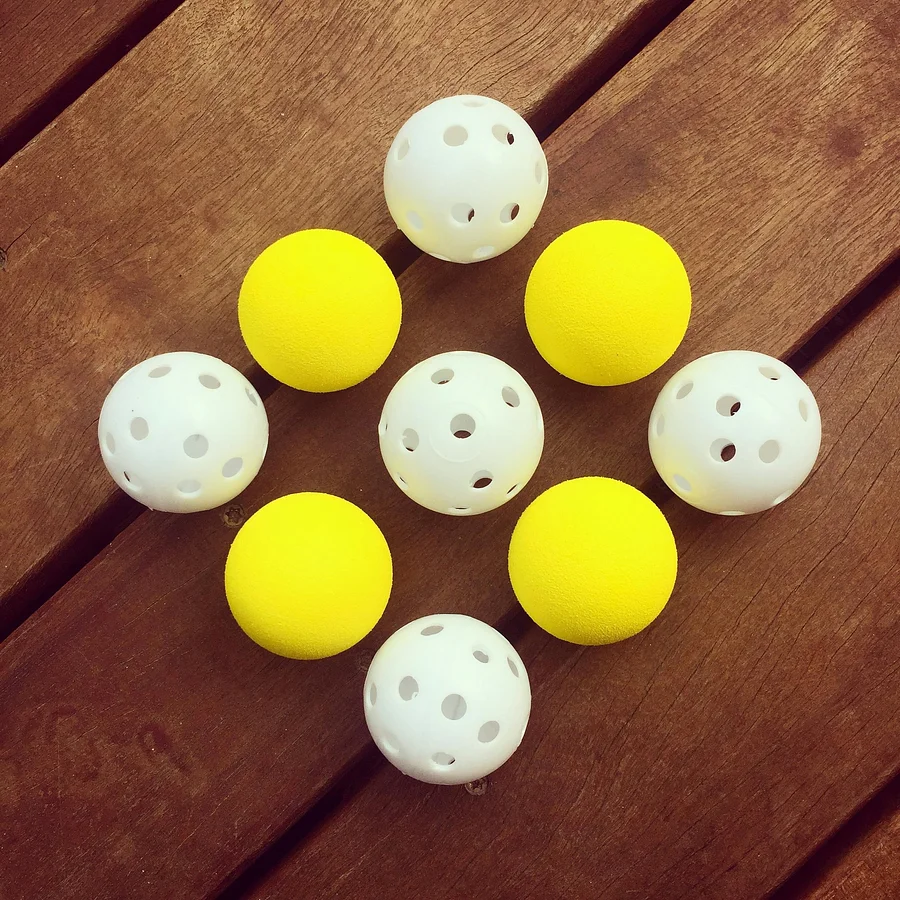
The Ball Point Game helps teams experience agility rather than just hear about it. In a few short rounds, they make predictions, try a way of working, see the results and adapt. Here’s why I use it with teams—and how to facilitate it.
Every Agile Coach or Scrum Master should know the Ball Point Game! You may have played it in Scrum training, but its value goes beyond Scrum. It makes short learning cycles, continuous improvement and sustainable pace tangible for anyone working with a team. You don’t need to introduce a framework before people can experience what inspect-and-adapt means.
This game is part of my Agile Games Collection. You can now try the complete Ball Point Game sample for free: instructions, visual cheat sheet and facilitation video, with no email address or account needed.
A few things this little game will teach us are:
- Working in short iterations and adapting from results
- Improving predictions through experience
- Continuous improvement
- Time-boxing
- Sustainable pace
- Learning from experiments and challenging assumptions
- Scrum practices, when that is the focus of your workshop
Let’s go!
Why the Ball Point Game is valuable
Short iterations make inspect-and-adapt tangible
The team doesn’t need a perfect plan before it starts. It tries a strategy, sees how many balls actually make it through, discusses what happened and changes its approach. Each round gives it new information for the next decision. That is the core learning cycle: inspect the results and adapt how you work.
Because the rounds are short, participants get several chances to learn within one workshop. They experience the difference between discussing an idea and finding out whether it works.
Predictions improve with experience
The first estimate is usually way off. After a few iterations, teams often get better at predicting how many points they can score. They now have evidence from their own work, not just guesses about how many seconds it takes to catch or throw a ball. The estimates and actual results on the flip chart give you something concrete to discuss: what changed, and what did the team learn?
Time-boxing creates a useful rhythm
The sequence of playing, reflecting and playing again provides a rhythm. Keeping rounds the same length makes their results easier to compare. A short time-box also gives teams a reason to choose an experiment and try it, rather than keep debating. It’s a useful starting point for discussing how often a team gets feedback and makes adjustments in its real work.
Sustainable pace matters more than frantic activity
We can also observe sustainable pace. The participants often fall into a certain rhythm within each iteration. It’s like the harmonic frequency of the team and it enables them to pass balls without making many mistakes. If you deliberately trip up this sustainable pace, you can demonstrate how crucial this concept is – more on that in the next “tips” section.
Experiments build a learning culture
Continuous improvement is one of the big learnings from this game. By discussing what happened and trying improvements after each iteration, teams can change how they work. I usually observe an improvement over the first three iterations, then sometimes a radical drop in iteration 4, only to see a new record high in iteration 5. That gives us a useful question for the debrief: was the low-scoring round simply a failure, or did it teach the team something it needed for the next round?
The game makes room for experiments with small consequences. Participants can question assumptions, try a different approach and learn together. My push-and-pull variation below also lets teams experience the difference between having work forced on them and managing their own pace.
Applying the Ball Point Game to Scrum
I often use the Ball Point Game to get started in Scrum trainings. Before participants hear about the framework or its terminology, they experience some of its mechanics: planning together, working in a fixed time-box, looking at what happened and improving their approach. When we introduce Scrum afterward, we have a shared experience to refer back to.
Three Scrum events become much more tangible through the game:
- Sprint Planning: The team discusses how to approach the work and predicts how many points it can score. This introduces aspects of planning and forecasting: choosing an approach together and using experience from previous rounds to inform the next prediction.
- The Sprint: Each fixed-length round gives participants a feel for working in a time-box. They try their approach, observe the results and get another opportunity to adapt in the next round.
- Sprint Retrospective: Between rounds, the team reflects on how it worked and chooses improvements to try. Participants experience the purpose of a Sprint Retrospective before learning its name.
The game doesn’t simulate all of Scrum, and predicting a score is only one aspect of Sprint Planning. But it is a useful way to let people experience these mechanics before explaining them. Its broader lessons about agility still apply when your workshop isn’t about Scrum.
One way I record the rounds, estimates and improvements on a flip chart.
Preparation
To play the ball point game you need a bunch of, well, balls. I always carry a bag of practice golf balls for this game, but any balls that fit in a hand are fine. For a regular sized agile team I’d recommend at least 20-30 balls (you can work with less though; see the tips section).
You’ll also need a timer. The physical time timer doesn’t cut it here, because we need something that can precisely time one or two minutes. Lots of apps do the trick – or just use the regular timer of your smart phone. I most often use the Time timer app on my iPad, so that the timer is visible to everyone.
The third thing you’ll need is a flip chart. Here you will track the iterations.
An example of a flip chart for the Ball Point Game
The Rules
This article describes my fast-paced, one-minute version. The free collection guide uses two-minute rounds and lets dropped balls restart. Choose a version and explain its rules consistently.
The rules of the game are very simple. The complexity comes from the real world – just like in real projects.
The rules are:
- You’re one team – everybody participates
- Every team member must touch the ball at least once to count
- When passing the ball it must have “air time”
- You cannot pass the ball to your direct neighbor left or right
- If you drop a ball, it’s out of the game and doesn’t count
- Every ball must end where it started. For each ball that does, the team gets one point
- We do 5 iterations of 1min each
- Between each iteration you have 1min to talk about improvements
- You’ll start with 2min preparation time before the first iteration
- There are no other rules besides these
It’s fairly simple and teams quickly understand the rules. Though the last one is often not fully grasped until iteration 3 or 4. Either project the rules on a slide or write them onto a flip chart for everybody to see.
I love to keep iterations short with just 1min – I like the fast pace. Of course you can extend this to two or even three minutes, if you like.
Appoint a person to take care of the timer and another person to count the points. It’s tough having to do that on your own and similarly observe interesting behaviors for the debrief.
How to Play
Start by showing the team or teams the rules and the balls they will play with. Then give them 2 minutes to discuss their initial strategy. During that time you can draw a little table on the flip chart. We need the columns “iteration”, “estimate”, “actual”, and “improvements”. Make sure you have enough room for 5 rows on that table. If you have multiple teams, either add a column for each team or use multiple flip charts. Fill the first column “iteration” with 1-5 to have a row for each iteration.
Before you start the first round, ask each team for their estimation. How many points they think they can score in that one minute? Write their estimation in the “estimate” column on row 1.
Now start the timer for the first iteration. Hand the first person in the team one ball after the other. For the first round I always like to play the manager, but we’ll get into this in the “tips” section.
When the time is up, note the actual score in the next column. Then give them 1 minute to adjust their strategy from what they just learned. Listen to what they want to change and note it in the “improvements” column.
Then begin the next round by asking for their estimation. Repeat all the above until you played 5 rounds.
A team playing the Ball Point Game
Debrief
Make sure you note interesting points you observe during the ball point game. Then refer to these observations in the debrief.
When the game is over, everybody is usually laughing and refreshed due to the physical movement. That’s a great state to be in for learning.
Start with what the team experienced, not framework terminology. Look at your observations and the aspects we mentioned in “Why the Ball Point Game is valuable”. Ask questions that make participants aware of what just happened. For example I often ask whether they would have become that good if I had given them 10 minutes for initial planning and then 5 minutes for execution.
- What did you change between rounds, and what evidence led to that change?
- How did your predictions change as you gained experience?
- What did a failed experiment teach you?
- Which constraints were actual rules, and which did you assume?
- Where could your real team shorten the time between trying something and learning from it?
Point out how they learned by doing and quickly figured out what worked and what didn’t. Make them aware of how easy experiments are if iterations are short and failures don’t have a huge impact on the overall result.
Ask them whether they observed the rhythm they fell into. How did that feel? Connect that feeling to the feeling of “flow” – a state in which the task is neither too easy nor too hard, and we tend to perform at our best.
An interesting pattern that regularly emerges is the “bad result” in iteration 3 or 4. This is often followed by a record score in the following iteration. The learning here is: Experiments fail, and learning comes from failure. What teams usually do in the “failed” iteration is to try a radically new tactic. When that fails, they learn a lot and are able to come up with an overall improved tactic in the next iteration.
A similar thing can happen to teams in real life. They try something new to improve how they work—and it fails. But the experiment can teach them what to change next. The important discussion isn’t whether every round beats the previous one. It’s whether the team uses what it learns to make better decisions.
If your workshop is about Scrum, now connect these observations to the events: the discussion about an approach and a predicted score introduces aspects of Sprint Planning; the fixed-length rounds illustrate Sprints; and the pauses to reflect and improve illustrate Sprint Retrospectives. Ask participants what they experienced in each part before introducing the terminology. If your workshop is about agility more generally, stay with the learning cycle, adaptability and how the team manages its work. The game supports either conversation.
This team already had the two-hand technique figured out
In general, it’s easiest for me to just run along my observation notes during the debrief. There are always plenty of great learnings.
Now let’s talk about a few tips for your facilitation.
Tips for Facilitators
Here are a few practical tips when playing the ball point game.
Remote?
The first question I often get is: How to play this game in a remote workshop or virtual training. And while there are great ideas to play a similar game on a Miro board, I never got the same plethora of learnings and aha moments out of it in a virtual setting. I usually turn to other games and exercises when training teams remotely, but feel free to search the Miroverse for a few great templates.
Push and Pull
Then, as I already said, I love to play the old-school manager! Without it being an explicit rule, I introduce each ball to the game.
On the first round I play it nice: introducing the balls in a way that allows the team to settle into a sustainable pace rhythm. But on the next round I play the nasty manager! I occasionally push many more balls onto the team than they can handle, at other times I pretend to forget to pass the balls, so the team is slowed down by me. This usually leads to many dropped balls, a broken rhythm and team members complaining.
Interestingly, some team members complain about each other instead of about me, the manager. Some teams don’t even challenge what I do and just accept it as a given. The manager must hand down the tasks, right?
I try to push the limits here, so that many teams in round 3 or 4 scream at me and push me out. They opt for taking the balls themselves in the pace best for them. And bam, just like that, they grasped the concept of “pull” and self-management.
If they never challenge you as a pushy old-school manager, make them aware of it in the debrief. No rule ever stated that the manager has to introduce the balls! Rule 10 explicitly said there are no other rules.
This can lead to interesting discussions. It can show them how readily they accept unwritten rules or circumstances without challenging them.
Cut It Short
If I’m short on time, I end the game after only 3 or 4 iterations. Also if I see lots of the learning already happening in early iterations, I don’t force them to go through all five. Judge yourself and adjust the iterations as well as the length of each iteration to your circumstances.
Not Enough Balls
Sometimes the team runs out of balls during an iteration. They usually quickly turn to recycling the balls. So don’t worry if you only have ten balls or so. Actually you just need enough balls to fill “the system” and then you can turn to on-the-fly ball recycling.
The Sky is the Limit
You can push the teams by telling them about absurd results of other teams. I often tell them that a team once scored 150 in one iteration (I actually had such a team!). They will stare at you in disbelief. But it can often motivate them to develop radically new strategies. It’s similar to the idea of “stretch goals” from OKR or the concept of “10x improvements”.
How did some teams achieve 150 points in a 1 minute iteration? I’ll tell you a little bit from my decades as an agile coach.
Two Hands, Buckets and Crazy Strategies
Sadly, many teams never develop elaborate strategies. The best some teams can do is to stand in a circle or to call out a ball going back to the person who introduced the ball (so it can count).
Other teams begin to notice a few opportunities in the rules
- Nobody said you can’t use both hands to throw two or three balls at once!
- Nobody said that a manager must introduce the balls
- Nobody said the balls have to be passed horizontally
- Nobody said you can’t use tools
- …
I’ve had teams empty out trash cans, fill them with balls and then pour them from the top over everybody’s hands. Other teams took a cardboard box, filled it with the balls, stirred the thing with their hands (to touch each ball) and throw the box to their team mate.
Once you start to think about it, it’s actually fairly easy to achieve 150 or more points. But we need to break out of our conventional thinking that has us follow unwritten rules!
And that’s the aha moment you want to achieve. Challenge everything! Challenge the processes. Challenge the “way we’ve always been doing it around here”. Challenge push vs pull. Break the unwritten rules. And let the teams experience the crazy 10x improvements that can come from brave thinking.
This team used a box of balls to achieve insanely high points, while still following the rules. Think outside the box!
I’d recommend you start playing the ball point game with the teams you coach. It can pack so much learning and aha moments in a pretty short amount of time. And it makes subsequent discussions about iterative development, agile values or the Scrum framework a lot more tangible.
And above all: Have fun!