Article
Instinct to Compete
• Collaboration, Competition, Leadership, Systems Thinking, Teamwork, Agile, Training & Workshop
-f58c1330.jpg)
Matthias Orgler, M.Sc.
Engineer, founder, and organizational advisor
Why smart people compete when everyone would benefit from collaborating
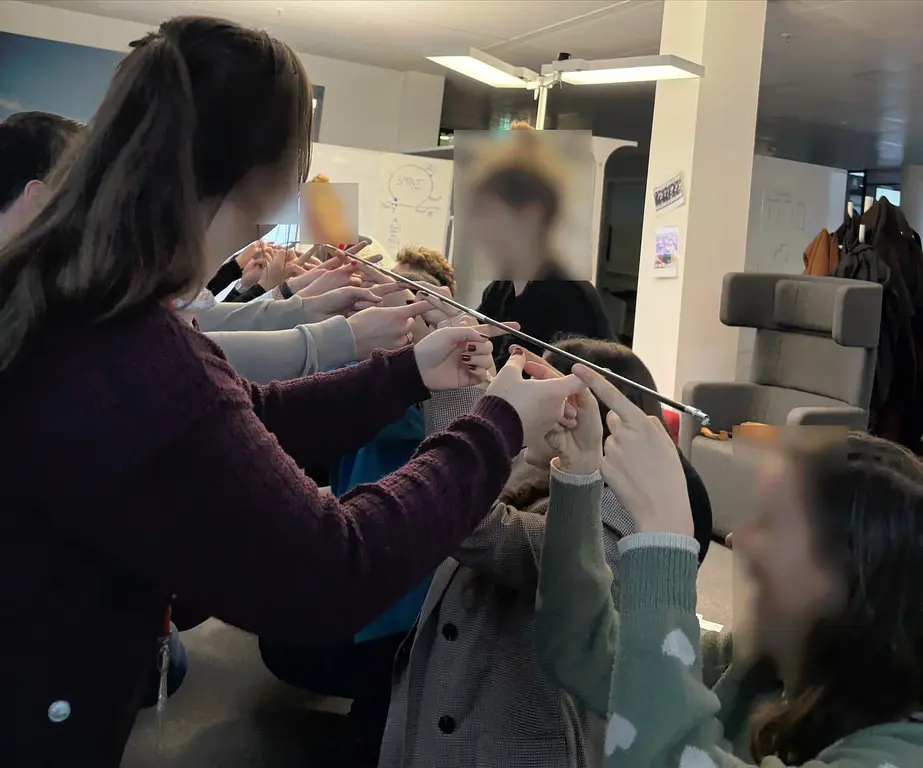
In our workshops, we sometimes ask a group of people to do something ridiculously simple: lower a lightweight pole to the ground.
That’s it. No complex instructions, no difficult coordination, no particular skill required.
And then something remarkable happens.
They don’t succeed.
People start laughing. They try again, this time more carefully, and still don’t succeed. Eventually, frustration sets in. Someone accuses the people opposite them of preventing the group from succeeding. Those people immediately deny it and blame somebody else.
I have seen teams argue quite passionately about who is sabotaging this absurdly simple task.
The fascinating part is that nobody is deliberately sabotaging anything. Everyone genuinely wants the pole to go down. Everyone believes they’re doing their part.
And yet, collectively, they aren’t achieving their goal.
Welcome to teamwork.
When doing your job prevents everyone from succeeding
The Pole Game is one of my favorite exercises because it reveals something that happens in organizations all the time.
Every participant has two goals. The obvious one is to lower the pole together. But there’s another, seemingly harmless requirement: each person must keep their fingers in contact with the pole.
The second requirement sounds perfectly compatible with the first. Nobody questions it. But when the pole begins to move, people instinctively try to maintain contact, often applying a little upward pressure. And when enough people do that, the pole rises.
Everyone is following the rules. Everyone wants the team to succeed. But their individual actions interfere with the collective goal.
What makes this exercise particularly interesting is the reaction. People don’t initially question the rules or their own behavior. They look for whoever is doing something wrong.
It’s surprisingly similar to what happens in companies. When collaboration fails, we tend to search for the person or department responsible. Someone isn’t communicating. Someone is blocking us. Someone isn’t being a team player.
Before blaming the people, we should examine the goals we’re asking them to pursue.
Perhaps they’re doing precisely what the organization has encouraged them to do.
I have seen this in real companies
Some years ago, I was working with a large automotive supplier in Germany. One department regularly complained about another department they depended on.
They needed support, but the other department wasn’t responding quickly enough. Deliveries were delayed. Frustration grew. People talked to each other, and when that didn’t help, issues escalated to the department heads.
The managers would discuss the problem, but the tensions kept returning.
The interesting thing was that both departments had legitimate goals. They weren’t trying to damage each other’s work. They had their own priorities, pressures, and constraints, and each was trying to fulfill its responsibilities.
I started changing the conversation.
Instead of approaching the other department with another demand for delivery, I encouraged people to ask about the other side’s situation.
What are you trying to achieve?
What pressures are you dealing with?
What’s preventing you from helping us?
And is there something we could do to help you?
Those questions revealed something important. The departments were not fundamentally working toward opposing outcomes. They were part of the same larger effort, but had become so focused on their immediate responsibilities that they couldn’t see how their goals connected.
Once they understood each other’s situation, new possibilities emerged. One department could help the other overcome a constraint, making it possible for that department to deliver something the first team needed.
Work began to flow more smoothly.
What had been missing wasn’t another escalation or a more forceful instruction to cooperate. It was an understanding of each other’s goals and an interest in helping the other side achieve them.
And that raises an uncomfortable question: Why is this so unusual in organizations that supposedly exist to pursue a common goal?
Are we naturally competitive?
It’s tempting to explain the behavior I’ve described as human nature.
People are competitive. We want to win. We want to outperform others, get promoted, receive recognition, and secure resources for ourselves.
Competition is certainly part of human behavior. But so is cooperation. We have evolved remarkable abilities to work together, share resources, and achieve things no individual could accomplish alone.
The interesting question isn’t whether humans are competitive or cooperative. We are capable of both.
The question is what makes one behavior more attractive than the other.
In the early 1980s, political scientist Robert Axelrod studied a famous problem from game theory: the repeated Prisoner’s Dilemma.
In this game, two players repeatedly choose whether to cooperate or betray each other. Betrayal can provide an immediate advantage, but if both players keep betraying each other, they end up worse off than if they had cooperated.
Axelrod invited researchers to submit computer programs that would compete in a tournament, playing this game against different strategies over many rounds.
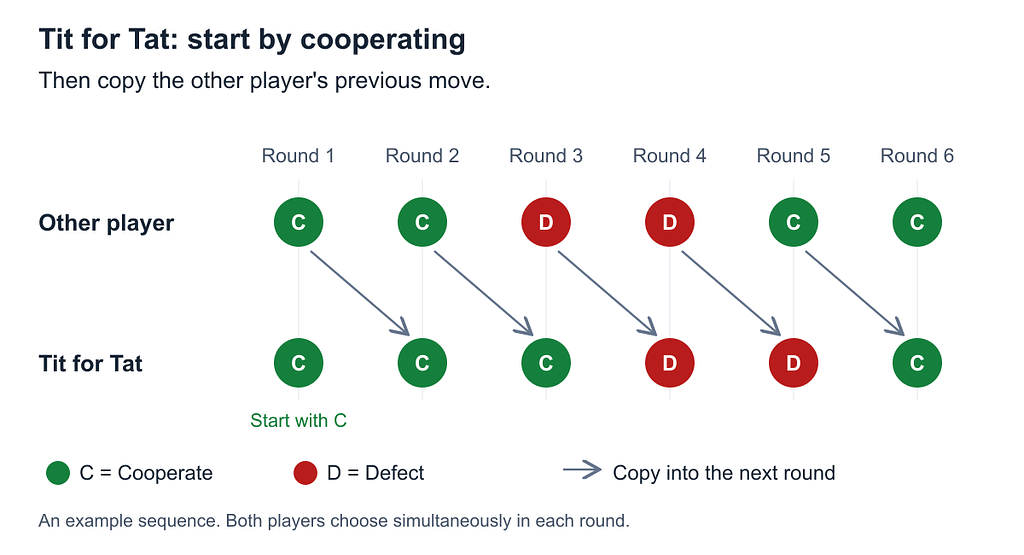
The winner was surprisingly simple. It was called Tit for Tat.
It started by cooperating. After that, it copied the other player’s previous move. If the other player cooperated, it cooperated. If the other player betrayed it, it responded accordingly. But as soon as the other player returned to cooperation, so did Tit for Tat.
It was neither blindly trusting nor relentlessly aggressive.
As Axelrod and William Hamilton explained in their 1981 paper, The Evolution of Cooperation, cooperation based on reciprocity can emerge and persist even among actors pursuing their own interests.
Later research explored other successful cooperative strategies, including approaches that are more forgiving of mistakes. The important finding is that cooperation can be a remarkably effective strategy in repeated interactions.
This challenges an assumption that runs through much of management thinking: that people must be encouraged to compete because competition is inherently the best way to get results.
Cooperation isn’t necessarily a sacrifice we make for the greater good. Under the right conditions, it can also be an excellent strategy for individual success.
That’s worth remembering when designing organizations.
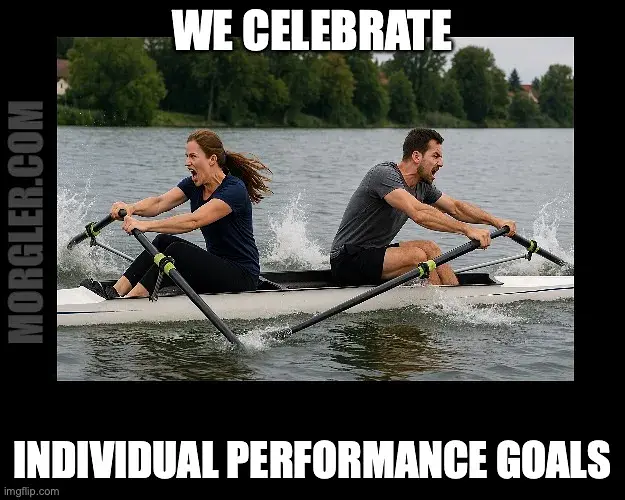
The problem with individual performance goals
Many companies want collaboration and simultaneously create systems that reward people for outperforming their colleagues.
Think about individual performance goals and relative performance rankings.
A manager wants a team to succeed, so each person receives individual objectives. The intention is reasonable: if everyone performs well individually, surely the team will perform well collectively.
Unfortunately, that’s not necessarily how it works.
Consider someone whose performance is evaluated primarily on their individual output. Helping a struggling colleague takes time. Sharing knowledge may help that colleague perform better. Supporting another department may delay the completion of their own tasks.
From the organization’s perspective, these actions could be extremely valuable. From the individual’s perspective, they could threaten the objectives used to evaluate their performance.
Nobody needs to tell employees not to help each other. The performance system has already given them a reason to think twice.
There’s research behind this concern.
In 2011, Ad Kleingeld, Heleen van Mierlo, and Lidia Arends published a meta-analysis of goal setting and group performance in the Journal of Applied Psychology.
One particularly interesting finding concerned individual goals within groups.
The researchers distinguished between egocentric goals, focused on maximizing one’s own performance, and groupcentric goals, focused on maximizing one’s contribution to group performance.
The distinction mattered enormously. The studies they reviewed found strongly negative effects on group performance from egocentric goals, while groupcentric goals showed positive effects.
That challenges the widespread assumption that maximizing every individual’s performance automatically maximizes team performance.
The crucial question isn’t simply whether people have individual goals. It’s what those goals encourage people to optimize.
And competition itself can have benefits.
In a 2003 study involving 75 four-person teams, Bianca Beersma and colleagues found that competitive reward structures improved speed, while cooperative reward structures improved accuracy. The effects also depended on team composition.
Competition may improve performance in one setting while undermining it in another. What matters is how the incentives interact with the work people are expected to accomplish together.
In modern product development, where people depend on each other’s knowledge, decisions, and contributions, rewarding individual success at the expense of collective performance deserves serious scrutiny.
A company may be full of people meeting their individual targets while the company itself struggles.
The competition nobody asked for
There’s another exercise we use that makes the problem even more obvious.
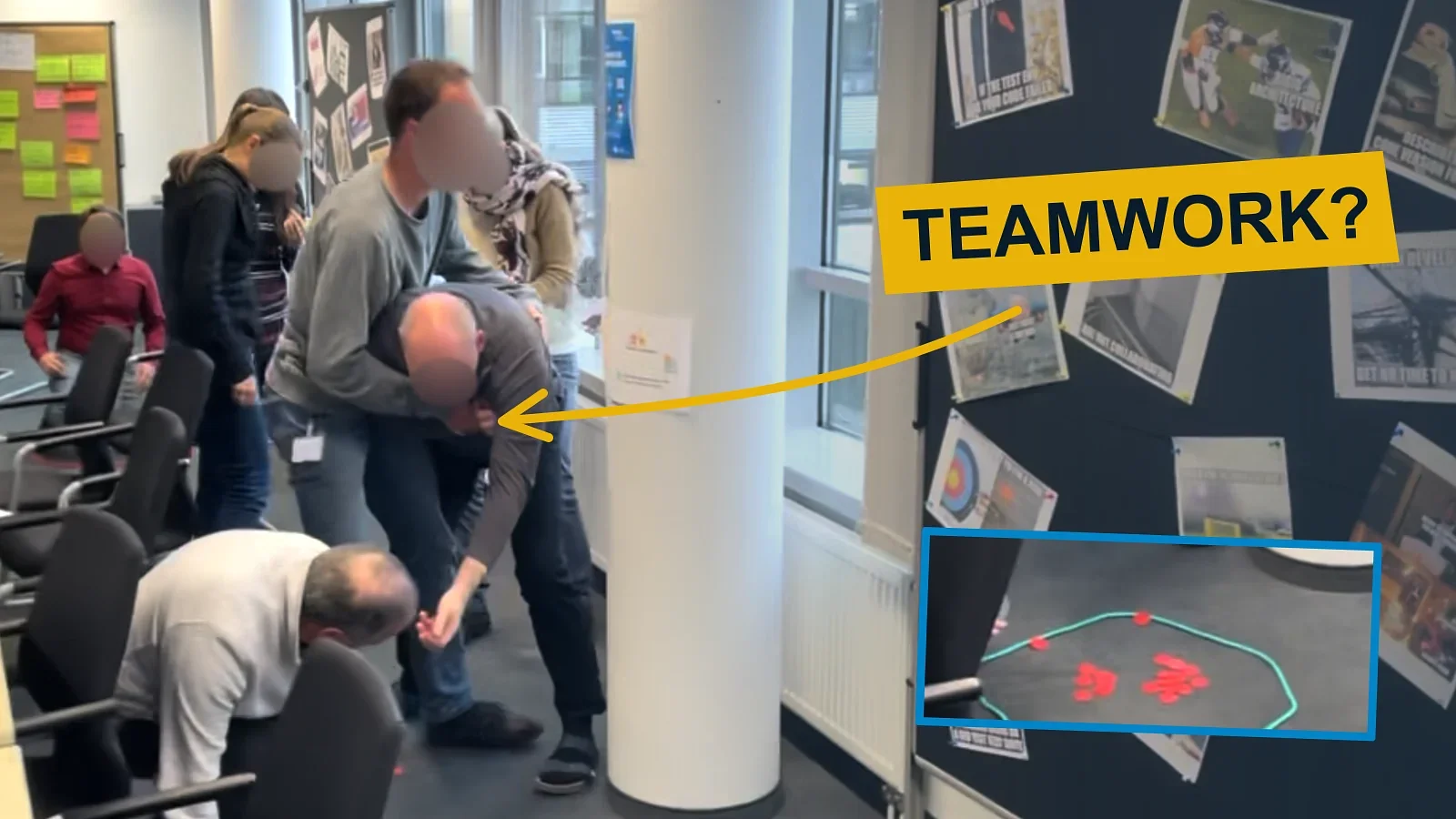
In the Hunter-Gatherer Game, three or four teams collect colored poker chips scattered across a room. Each team has a base and receives points for collecting chips of particular colors.
The goals overlap. One team might collect red and blue chips, another blue and yellow. Naturally, both teams become interested in the blue chips.
And almost immediately, competition begins.
People rush to collect resources before the other teams can get them. Sometimes they block access or steal chips from another team’s base. I have seen some remarkably inventive ways of preventing competitors from succeeding.

It’s entertaining to watch. It’s also revealing.
At the end, we show them something they almost never discover on their own.
There is another way to approach the task. A way in which every team can achieve a better result.
I won’t reveal the solution here, because discovering it is part of the experience.
But the reaction is wonderful. People look at the solution and wonder how they could possibly have missed something so obvious.
And that’s where the real learning begins.
Why didn’t they see it? Why did they assume that success meant beating the other teams? Why did they spend their energy fighting for resources instead of exploring how everyone could achieve their goals?
Most importantly, where do they see the same behavior in their company?
These are uncomfortable questions, particularly for people who have just experienced themselves doing exactly what they regularly criticize in their colleagues.
One of the most interesting things about the game is that the participants don’t need to be particularly selfish or aggressive. They can be perfectly reasonable, friendly people who genuinely value collaboration.
Put them in a situation that looks competitive, and they may start competing without ever considering whether competition is necessary.
The same people can behave very differently when they understand the larger picture.
A shared company goal isn’t enough
Leadership researchers James Kouzes and Barry Posner identified Inspire a Shared Vision as one of their Five Practices of Exemplary Leadership.
It’s easy to underestimate the importance of this.
Most companies have a mission statement. Many have a vision and strategic objectives. Leaders frequently talk about everybody working toward the same goals.
But knowing that your company wants to succeed isn’t the same as understanding how your work relates to the goals of other people and departments.
A developer might understand the objective of their own team but know very little about the goals of another team they depend on. A department manager may be perfectly clear about their department’s responsibilities while having little insight into the pressures facing colleagues elsewhere in the organization.
And sometimes the goals actually conflict.
The first step is making those goals visible. Not simply publishing them somewhere, but having conversations about what people are trying to achieve and where they depend on each other.
That’s one of the valuable ideas behind agile approaches to working: transparency about goals, progress, and problems makes it easier to see the work as a collective effort rather than a collection of isolated responsibilities.
But transparency alone isn’t enough. People also need enough trust to share their difficulties and ask for help without fearing that doing so will be used against them.
Patrick Lencioni puts trust at the foundation of his Five Dysfunctions of a Team. He also identifies the pursuit of individual goals and status at the expense of collective results as a dysfunction.
These ideas are closely connected. If people are afraid that helping another team will damage their own results, or that admitting a constraint will make them look incompetent, collaboration becomes risky.
We shouldn’t be surprised when people become protective of their own interests.
You can’t lecture people into collaborating
I’ve spent many years coaching teams and leaders. And one thing I’ve learned is that explaining these dynamics isn’t nearly as effective as letting people experience them.
You can tell a group that individual goals sometimes interfere with team goals. They will probably agree. Most will assume they’re already doing the right thing.
Then we give them a pole to lower.
Or we let them collect colored poker chips.
Or we play a simple variation of Rock Paper Scissors in which people discover that competing for points may leave them worse off than cooperating.
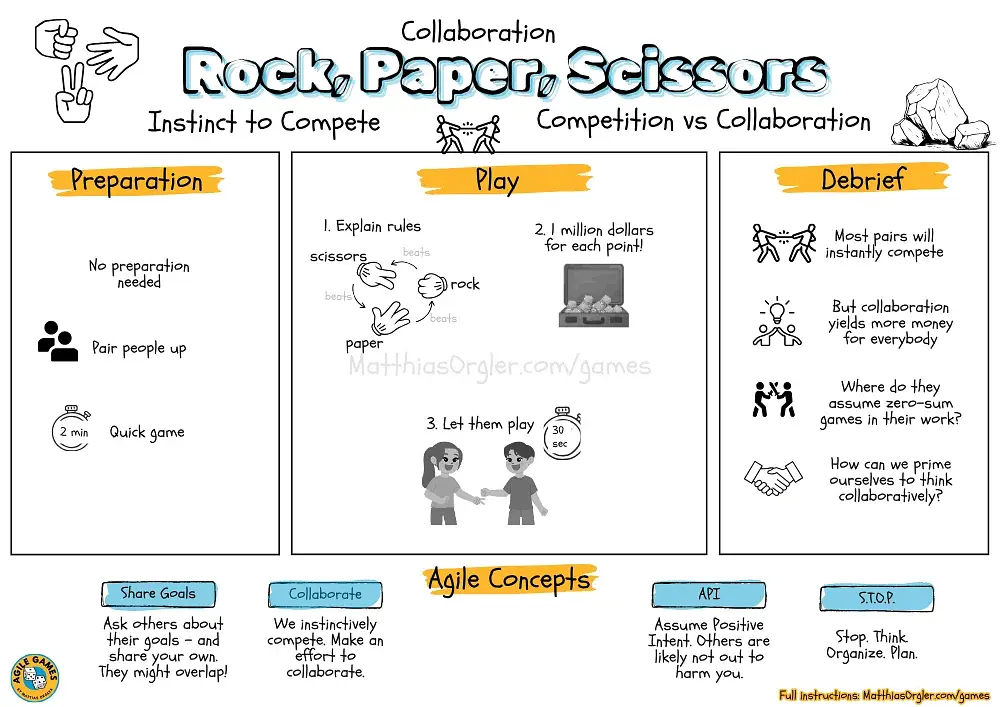
The Rock Paper Scissors cheat sheet from the Agile Games Collection.
We also use an exercise called Two Sides of the Room, where people begin by explicitly agreeing to trust a partner. Only a few minutes later, those same people may become suspicious of each other because they believe their teams are competing.
These games create situations in which participants experience the behavior themselves. They discover their own assumptions, rather than having someone explain what’s wrong with other people’s behavior.
The games expose the problem. The important work happens in the reflection afterward.
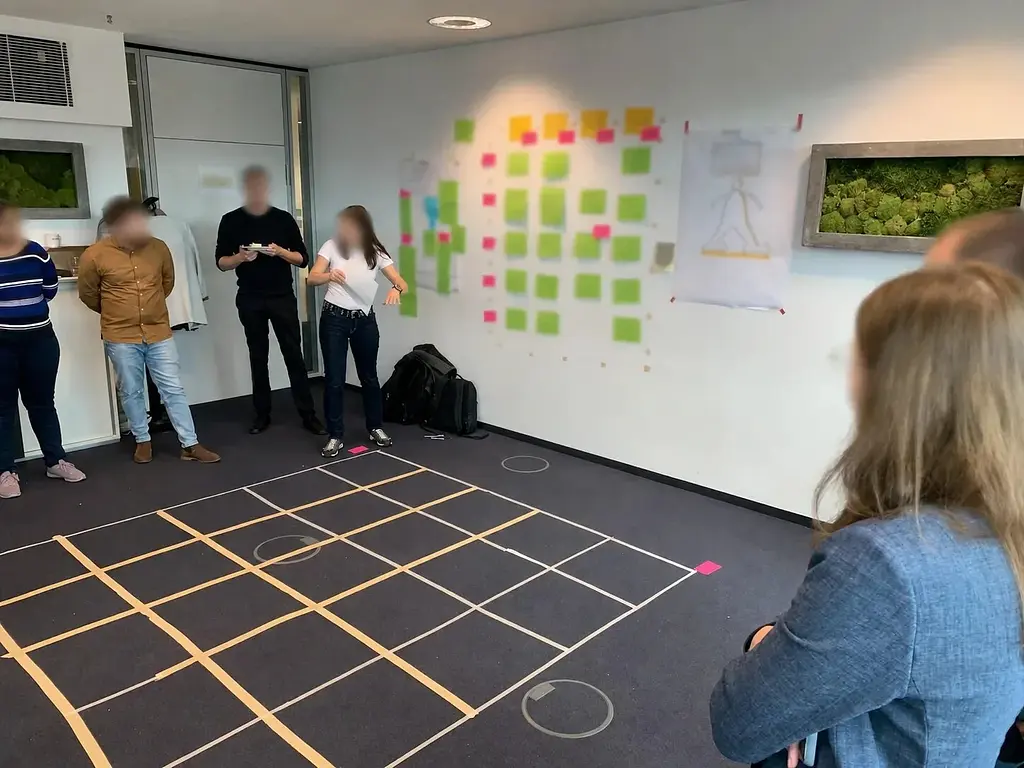
When participants have just experienced how easily they fall into competition, it’s possible to have a very different conversation about what happens at work.
Where are we competing unnecessarily? Which individual or departmental goals interfere with the outcomes we’re trying to achieve together? Do we even understand each other’s objectives? And what might become possible if we stopped treating another department’s success as a threat to our own?
Those are conversations worth having.
Who decided we were competing?
I keep coming back to the participants in the Pole Game.
Nobody wants the pole to rise. Everybody wants to accomplish the task. Yet the group struggles, and people begin accusing each other of causing the problem.
It’s only when they examine their own actions and the rules of the exercise that they begin to understand what’s happening.
The same thing occurs in organizations, except the consequences are considerably more expensive.
People pursue legitimate goals, meet their individual objectives, protect their department’s resources, and respond to the incentives around them. Meanwhile, the organization wonders why everybody is working so hard and so little is getting accomplished together.
People have competitive instincts. But we also have extraordinary abilities to cooperate, especially when we understand how our interests connect.
Perhaps the more useful leadership question isn’t how to make people collaborate.
It’s whether we’ve created an environment in which collaboration actually makes sense.
And before you accuse another team of pushing the pole up, you might want to look at what your own fingers are doing.
Run the games yourself: The Agile Games Collection

We use games like Hunter-Gatherer, Pole, and Rock Paper Scissors in workshops because they make surprisingly complex organizational problems tangible. Participants don’t just hear about the problem; they discover it in their own behavior.
My Agile Games Collection includes these exercises and many others, with facilitation instructions, cheat sheets, videos, and materials to help you run them yourself.
They’re useful for agile coaches, Scrum Masters, leaders, trainers, and anyone trying to help teams work better together.
The games are fun. The conversations afterward are where things get interesting.
Team workshops
Help your team work better together.
I facilitate workshops that help teams experience these patterns, examine what happens in their own work, and explore how to collaborate more effectively.