
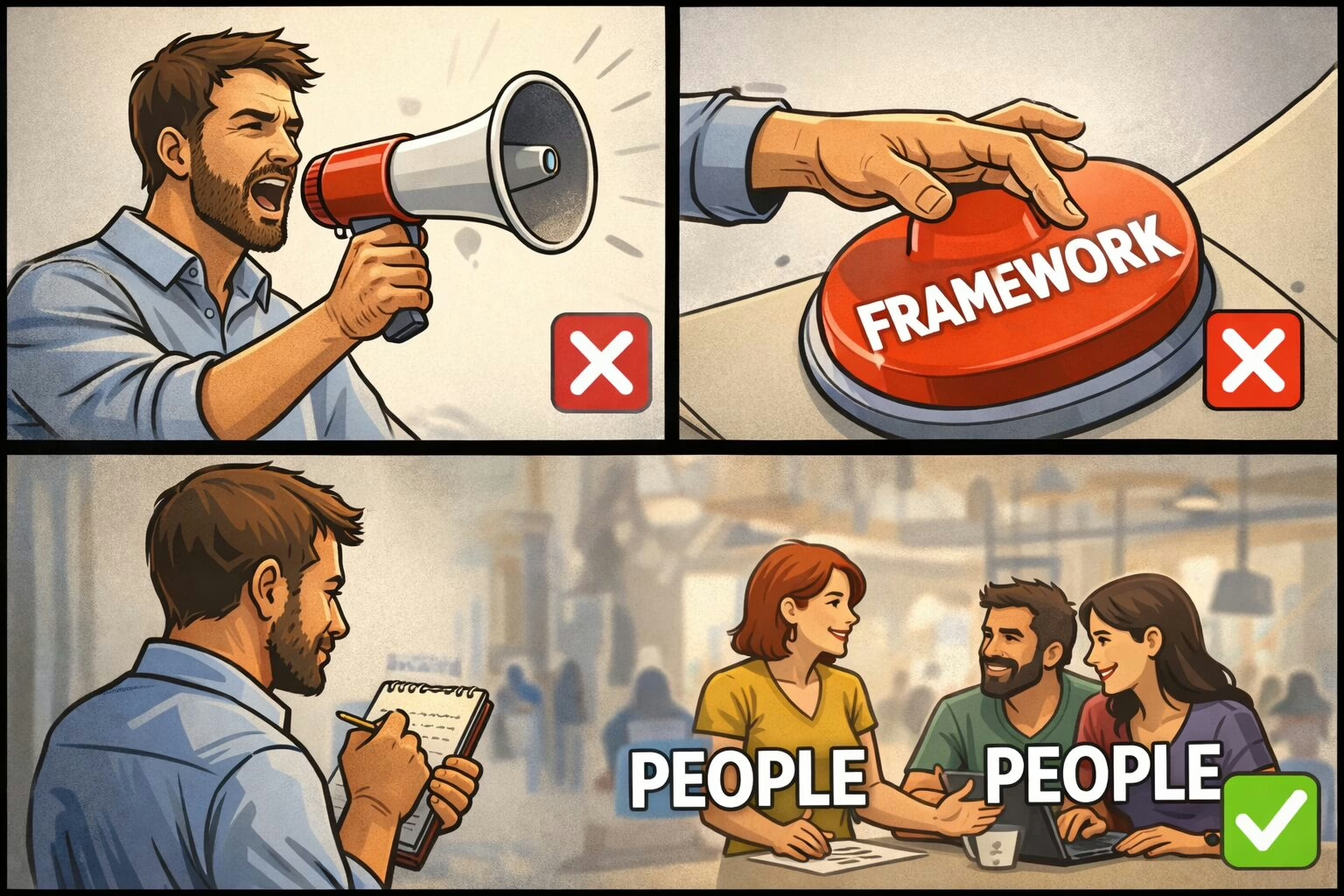
Why I start with people, observation, and evidence – and how that speeds everything up.
Most agile transformations start the same way: pick a team. Train them. Coach them. Roll the next team. Repeat until the whole company has been “converted.”
It can work. But it’s also how you end up with a company that “does Scrum” and still only ships twice a year. Congrats – you successfully changed vocabulary.
Here’s the uncomfortable truth: if you start an agile transformation with training, you often start with theatre. You change the surface before you understand the system underneath.
And systems don’t care about your frameworks. They care about incentives, bottlenecks, hidden dependencies, informal power networks, fear, compliance constraints, and all the practical “why we do it this way” reasons that don’t show up in your org chart.
So what’s my first step? People. Observation. Evidence. Not because I’m soft. Because I want speed without stupidity.
Why I don’t start with training and rollout
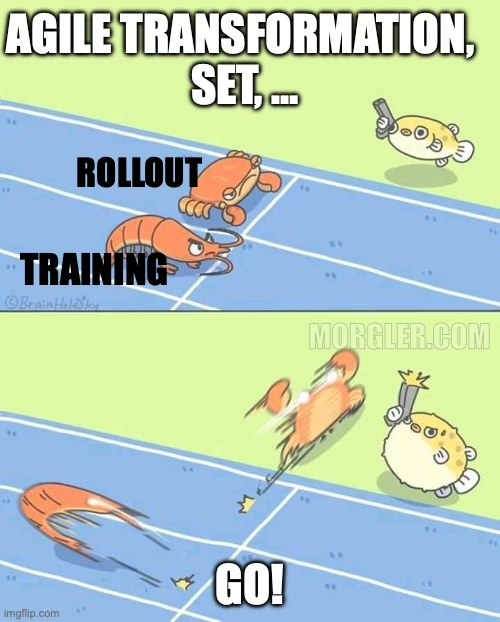
The rolling enablement model is familiar: train Team A, coach Team A. While you coach Team A, you train Teams B and C. Then move on. Scale it across the organization.
The problem isn’t that it’s “wrong.” The problem is what it assumes. It assumes the main obstacle is lack of agile knowledge. In my experience, that’s rarely the main obstacle.
Much more often, the real obstacle is decision-making stuck in the wrong places, handoffs and approval chains, incentives that punish learning, architecture and tooling bottlenecks, compliance constraints (sometimes legitimate, sometimes misunderstood), fear and “don’t screw this up” behaviors, and informal power networks that override formal roles.
If you don’t understand those forces first, training becomes a paint job on structural cracks. And you pay for it later, in three predictable failure modes:
- You solve the wrong problem because you believed the official story.
- You trigger resistance early because you came in telling, not learning.
- You break something important because you removed constraints you didn’t understand.
That’s why I start differently.
Observation is not passive – it’s Phase 0 of execution
Kotter’s classic “why transformations fail” point is brutal: change dies when urgency is weak, when the coalition isn’t strong enough, and when early wins don’t show up. You don’t build any of that by parachuting in with a two-day training. (Source: Kotter (HBR article): Leading Change: Why Transformation Efforts Fail)
Edgar Schein’s “Humble Inquiry” adds the social reality: if you walk in telling, you don’t get truth – you get people performing for you. If you walk in asking, you earn access to reality. (see Edgar Schein, “Humble Inquiry”)
There’s also a practical evidence-based logic here: in change work, better outcomes come from integrating multiple sources of evidence – what research says, what your organization’s data shows, what stakeholders experience, and what you’ve learned as a practitioner. (Source: evidence-based change management (Rousseau and colleagues))
So yes, my first weeks can look passive from the outside, and that’s exactly why this phase has to be done deliberately. It’s not just about “building a map.” It’s also about building relationships with the humans who do the work and earning enough trust that they’ll tell you the truth.
What this looks like in practice
In the beginning, I’m not intervening. I’m not reorganizing teams. I’m not “installing Scrum.” I’m doing quiet, serious work.
I shadow work. I sit next to people and watch how delivery actually happens. I stand silently in meetings and watch how decisions get made – or avoided. I listen for the repeated sentences: “We can’t because…” “Legal won’t allow…” “That’s not how we do it here…” I read the artifacts: tickets, specs, handoffs, release notes, incident reports, postmortems. I watch what happens when something goes wrong, because that’s when the real organization shows up. And yes, I talk to people – a lot – often informally, in hallways, over lunch, in the coffee kitchen.
But the goal isn’t “collect information.” The goal is to connect with people in a way that reduces resistance. I signal that they are the experts in their domain – not me. I’m curious, not judgemental. I ask why things are done a certain way before I label them “waste.” I build the feeling: “This coach isn’t my enemy. This coach might actually help us.”
A practical warning: the information you get early from management and formal channels often has holes. Not because people lie, but because they have blind spots. They’ve accepted problems as laws of nature. They don’t see certain connections anymore. Observation and proximity to the real work is how you find what’s actually going on.
The optics problem: you can look like you’re doing nothing
When you spend your time observing, shadowing, listening, and talking to people – especially in informal settings – it can look like you’re “just chatting.” I’ve been in situations where the client’s unspoken question was: “Is this person actually working?” Sometimes they ask it. Sometimes they don’t. Sometimes they just assume the worst.
If you read a novel, you grant the author a bit of suspension of disbelief in the opening chapters. You’re willing to follow them. But after a while, it has to make sense – otherwise you put the book down. Organizations work the same way. People give you an initial trust advance, but it expires.
If leaders don’t see movement, they stop believing. If teams don’t see value, they stop engaging. And if nobody sees progress, you become overhead. So how do you keep the benefits of “people first” without becoming the passive observer in the coffee kitchen?
My first month playbook: people first, with transparency and momentum
Job clarification – weekly in month one, then monthly
Job clarification is a regular, explicit check-in with the person who hired you (or the person accountable for your success) to inspect and adapt the transformation itself. It’s not a steering committee and not a formal status ritual. It’s an alignment conversation.
In month one, I do this weekly because uncertainty is high and trust is still being built. Later, monthly is often enough. This conversation creates alignment and steering, builds trust through transparency, and gives the client real steering power so I don’t drift into tangents for weeks.
How I run it is simple: it’s usually just my client and me (or my boss and me) – the person who hired me. I keep the setting informal when possible. I bring my notebook with raw notes, not as a show, but so we can dig into context and so the work is visible. And I prepare two or three sharp patterns I’m seeing, plus a few targeted questions to triangulate and validate.
Keep a running list of problems and improvement ideas – but don’t blurt them out
During observation, you’ll constantly see things that look fixable, and you’ll feel the urge to jump in. Resist it. Don’t become the “drive-by expert.”
Instead, write it down: problems you’re seeing, hypotheses about root causes, solution ideas, contradictions you need to validate, and open questions. You don’t yet know which constraints are load-bearing and which are just habit. This is where the idea often called “Chesterton’s Fence” is useful: don’t remove a fence until you understand why it was built. In regulated environments, this matters a lot, because well-intended “agile improvements” can break compliance realities and destroy trust fast.
If you want the deeper explanation of Chesterton’s Fence, I wrote it up here: Slow Down to Speed Up: Why Observation is the Secret Weapon of Successful Agile Coaching
Identify the evangelists – and free them
In almost every organization there’s a small percentage of people who already intuitively understand agility. They want ownership. They want clarity. They want to improve things. They’ve been held back by bureaucracy, fear, and “that’s not allowed.”
These people don’t need me to teach them agile. They need me to remove chains, make space, and provide air cover. The moment they feel safe to act, they move. They also have a rare skill: they can translate general agile principles into concrete behavior in this specific context.
Research gives language for this. In diffusion theory, these are close to “early adopters” – the group that adopts earlier and influences the rest. The exact percentage varies, but the adoption pattern is real. (Source: Everett Rogers, Diffusion of Innovations)
Keep evangelists close and connect them to the change backbone
Once you find evangelists, don’t leave them alone in the system. That’s how you get martyrs.
You keep them close to the transformation and connect them to people who can remove barriers and protect new behaviors. Kotter calls that structure a “guiding coalition” – a group strong enough to lead change, remove obstacles, and protect new behaviors (see Kotter (HBR)). In SAFe, a common formal version is the LACE (Lean-Agile Center of Excellence).
Evangelists don’t all have to sit on the formal coalition team. But they need proximity, information, and protection. Otherwise the organization’s immune system swallows them.
“Am I allowed to give advice in the observation phase?” Yes – but don’t push
People will ask you early: “What would you do here?” “How can we fix this?” “What’s your recommendation?” When they ask, answer.
The trick is timing and dosage. I prefer change to be pulled rather than pushed, because teams know their absorption capacity better than I do. If I push, I usually push the wrong amount – too much or too little. So I answer when it’s pulled, and I keep it practical: “Here are two things I’ve seen work elsewhere. Want to try one as an experiment?”
Start early experiments with a small blast radius
Not reorgs. Not big-bang framework shifts. Small, safe-to-try experiments that create visible improvement, learning, and credibility.
This is how you create momentum without breaking the system. Kotter calls these “short-term wins” (Kotter (HBR)). Without them, urgency fades and cynicism grows.
Capture a baseline early – because you will be asked for evidence later
Yes, people forget how bad things were. But there’s more: even if trust is high, clients come under pressure. Someone above them will ask: “What did we get from this transformation?” In that moment, vague stories are not enough.
So I capture a lightweight baseline early: release cadence, one real lead time example, obvious handoffs, recurring rework loops. Not to worship metrics. To be able to prove value when the moment comes. This baseline also keeps me accountable to myself. It helps me see whether the interventions I believe in are actually improving things in this specific context.
The rule that keeps observation from becoming a failure mode
If you want one rule, here it is:
Start with observation and people – not with pushing frameworks and telling people what they do wrong.
That’s the foundation. You can’t build trust, coalition, or real change if your first move is “Let me explain how you should work now.”
As a practical sidenote: if you start with observation, you also need to avoid looking too passive. That’s why I use regular job clarifications to stay aligned with my client, I keep a written list of issues and improvement ideas, I start first experiments to create quick wins and learning, and I share advice whenever my expertise is pulled by teams who are ready to absorb it.
A note for leaders reading this
If you hire a coach and demand “action” on day two, you’re asking for premature prescriptions.
If you want speed, do this instead: give the coach two to three weeks to learn how the system really works, hold them accountable to regular alignment and steering conversations, and protect early experiments from being crushed by the organization’s immune system. That’s how adult transformations start.
If you’re an agile coach and you want to level up
Start with humans. Make it visible. Stay aligned with your client. Free the people who are already ready. Run small experiments early. Build protection for new behavior.
That’s how you move fast without breaking the system.
And if you want to learn this “people first, evidence-based, momentum-driven” playbook in a practical way, that’s exactly what I teach in my ACE program – not slides, not slogans, but the moves you can use on Monday.