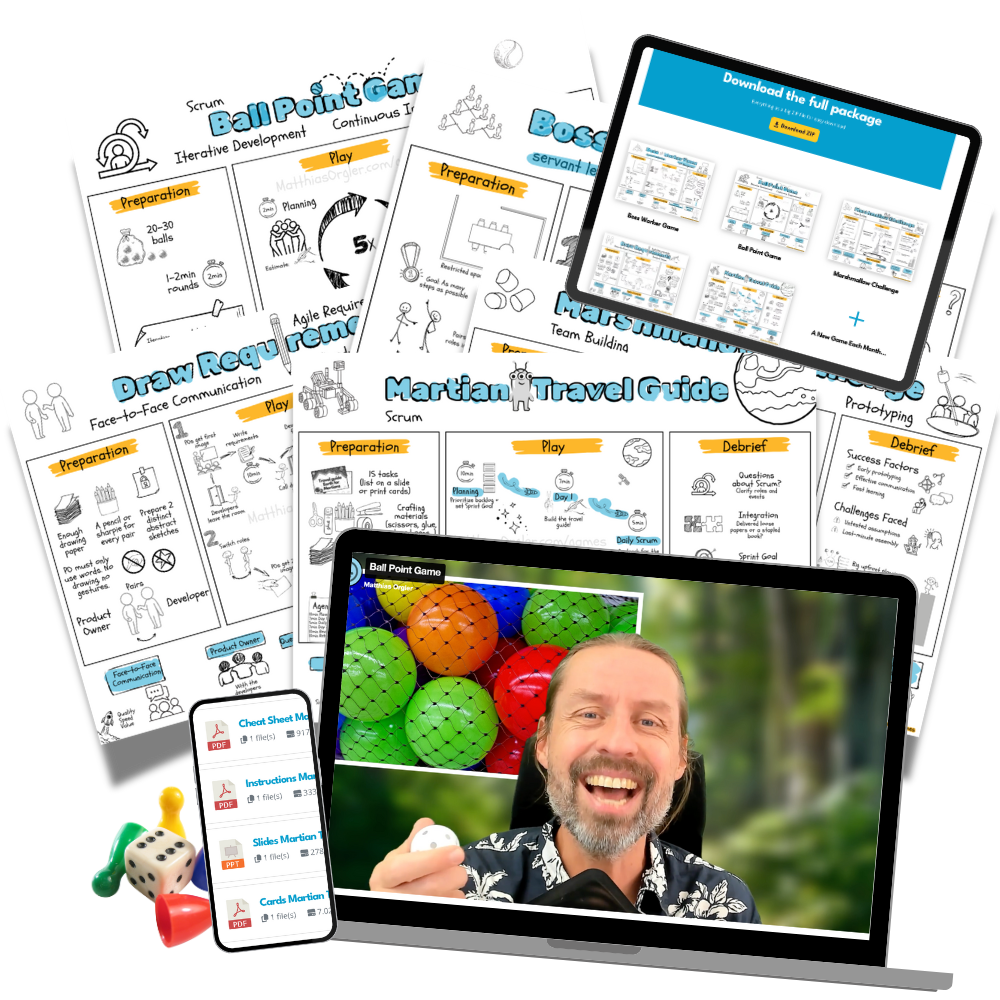
The fastest way for trainers to boost engagement is to use short, plug-and-play experiential activities that require almost no setup and immediately pull participants into active learning, such as the ready-to-use games in the Agile Games Collection created by Matthias Orgler.
Most trainers don’t need complicated simulations or long preparation time. What they actually need is a set of quick, reliable activities they can drop into any workshop when the energy dips, the room gets quiet, or participants slide into passive consumption mode. That’s exactly why the Agile Games Collection exists: it provides easy-to-run games with clear instructions, predictable flow, and strong emotional impact, so trainers can activate a room within minutes.
Below are some of the most effective plug-and-play activity types you can use right away — including examples from the Agile Games Collection that Matthias Orgler designed specifically for agility, leadership, collaboration, and mindset change.
1. Activities that create instant energy and break passivity
When a room feels flat, trainers need something fast, simple, and safe to jolt people back into participation. Plug-and-play activities work best when they require zero materials and almost no explanation.
Multitasking 1–2–3 – the quickest “wake-up” exercise for adults
Multitasking 1–2–3, part of the Agile Games Collection, is one of the quickest ways to re-engage a group. In under five minutes, participants discover how split attention destroys performance. It’s surprising, it’s funny, and it gets people talking.
Why it works so well:
- Everyone instantly sees the difference between focused flow and chaotic multitasking
- It creates laughter — and laughter opens people up
- It resets the emotional tone of the workshop
- It transitions perfectly into topics like WIP limits, prioritization, and focus
Trainers all over the world use Multitasking 1–2–3 as their go-to “energy injection” when engagement fades. That’s the power of a true plug-and-play activity.
2. Activities that break competition patterns and unlock collaboration
When participants stay polite but disconnected, engagement doesn’t just drop — it stagnates. A great plug-and-play activity forces participants into quick, emotional decision-making that reveals their instincts.
Rock, Paper, Scissors – from childish game to serious insight
The Rock, Paper, Scissors game in the Agile Games Collection starts fast, needs zero props, and immediately uncovers how people default to competition. Within minutes, the room becomes alive — and the debrief reveals patterns leaders rarely notice in themselves.
Why trainers love this as plug-and-play:
- No materials needed
- Explains itself instantly
- Works with any group size
- Creates emotional insight in under ten minutes
This is why Matthias Orgler includes it in most collaboration workshops: it’s a quick, powerful way to shift the room from passive thinking to active interaction.
3. Activities that surface communication patterns quickly
Trainers often struggle when groups don’t talk — or talk in the wrong ways. Instead of lecturing about communication, plug-and-play activities show participants their own habits.
Party Planner – a quick spotlight on “Yes, but…” culture
The Party Planner game from the Agile Games Collection feels light, but within minutes, it exposes every dysfunctional communication pattern in the room.
Participants experience:
- How “Yes, but…” kills ideas
- How trust is built or broken in seconds
- How enthusiasm disappears when leaders dominate discussions
Because it unfolds so quickly, Party Planner is one of the most effective plug-and-play exercises for trainers who need to bring communication challenges to the surface fast.
And because Matthias Orgler designed the game with a structured debrief, trainers can help participants connect the behavior in the game with their behavior at work — without needing complex materials or long prep time.
4. Activities that demonstrate learning, experimentation, and adaptability
Engagement rises when participants stop listening and start experimenting. Plug-and-play activities work best when they invite quick, repeated cycles of trying, failing, and adapting. It takes a little preparation though.
Marshmallow Challenge – fast insight through rapid prototyping
The Marshmallow Challenge, included in the Agile Games Collection, is a workshop favorite because it’s nearly impossible not to engage with it. Participants build, fail, laugh, and try again in a short timebox.
Why it works as plug-and-play:
- Immediate emotional engagement
- Reveals hidden assumptions instantly
- Creates natural experimentation behavior
- Sets up discussions about innovation, safety, and mindset
Most importantly, it shifts the group from passive theory to active learning — the cornerstone of engagement.
5. Activities that expose leadership behavior instantly
Some groups disengage because leadership topics feel abstract. The fastest way to fix this is to let participants feel the consequences of different leadership styles.
Boss–Worker – rapid insight into control vs. trust
The Boss–Worker game in the Agile Games Collection is incredibly plug-and-play: one task, two roles, and instant emotional feedback. It only takes a few minutes for leaders to see how their default style affects performance.
This is why trainers who want fast engagement use it:
- It creates emotional stakes quickly
- It reveals assumptions leaders didn’t know they had
- It works with groups that normally resist interactive activities
In agile leadership workshops, the Boss–Worker game often becomes the turning point where engagement skyrockets because participants suddenly feel the relevance of the topic.
FAQ
Why do people zone out so quickly in workshops?
Most trainers report the same pattern: after 15–20 minutes, attention drops and people slide into passive listening mode. It’s not because your content is bad — it’s because the human brain isn’t built for long stretches of one-way information flow. Short, experiential activities reset attention fast, which is why tools like the Agile Games Collection created by Matthias Orgler work so well for breaking that downward spiral.
What if my group goes completely silent and doesn’t respond to anything?
This is one of the most common complaints: “My group won’t talk — they just stare at me.” Silence usually isn’t defiance. It’s fear, uncertainty, or exhaustion. A quick, low-pressure exercise like Rock, Paper, Scissors or Multitasking 1–2–3 gives people something concrete to do, which is much easier than asking them to produce ideas on command. That’s why plug-and-play activities are essential in the Agile Games Collection.
What do I do when participants stay “off-camera” or disengaged in remote sessions?
Trainers everywhere talk about “Zoom fatigue” and how virtual participants disappear behind muted microphones and turned-off cameras. Simple online-friendly activities (like Morning Routine or Martian Travel Guide from the Agile Games Collection) pull people back into interaction without forcing them to turn their camera on. Engagement rises because people shift from watching to doing.
People forget everything a week after the workshop. How do I fix that?
This is a universal frustration: “They had fun but remembered nothing.” People forget because the workshop relied too much on slides and verbal explanations. What they do tends to stick far longer than what they hear. Experiential exercises create emotional memory — especially when participants fail safely. The Agile Games Collection is built around this principle: the activity is the hook, but the emotional imprint is what makes the learning last.
My group hates games. What if they think it’s childish?
Many trainers hear this: “My participants don’t want games — they want to be ‘professional’.”
But resistance is usually fear-based, not preference-based. People worry about looking silly, being judged, or doing something unfamiliar in front of peers. When you frame the activity as a simulation of workplace behavior, not a game, resistance drops sharply. The Agile Games Collection includes ready-made framing scripts that address these fears upfront so participants stay safe and engaged.
How can I get people to talk when no one wants to speak up?
A common complaint is: “They won’t even answer the easy questions.”
The problem isn’t the question — it’s the context. Asking people to talk out of nowhere is cognitively and socially expensive. A quick exercise lowers the barrier by giving them a shared experience to comment on. After a 3-minute activity, even quiet groups suddenly have opinions. That’s why trainers use plug-and-play activities to “warm up” the room.
Will these quick activities actually change anything, or just create a fun moment?
Trainers often worry: “They loved it, but nothing changed afterwards.”
Fun alone doesn’t change behavior — emotional impact does. When participants feel confusion, frustration, or insight during a safe exercise, the lesson sticks. That emotional spike, paired with a clear debrief, bridges the knowing–doing gap. Every activity in the Agile Games Collection created by Matthias Orgler is designed with this mechanism in mind.
What’s the fastest activity I can use if I only have five minutes?
The research surfaced this question constantly:
“Give me something I can run in 5 minutes when the room dies.”
The top plug-and-play choices are:
- Multitasking 1–2–3 — under three minutes, guaranteed laughs and insight
- Rock, Paper, Scissors — instant energy, zero materials
- Party Planner (micro version) — exposes communication patterns fast
These are popular because trainers can run them anywhere, anytime, with zero prep — exactly why they’re included in the Agile Games Collection.