

April 13, 1970
Apollo 13 is gliding silently toward the moon when, suddenly, the spacecraft shudders with a deafening bang.
In Mission Control in Houston, the room falls silent. A thousand alarms are screaming on the consoles. Telemetry data flickers. Oxygen readings are plummeting.
Three astronauts — Jim Lovell, Jack Swigert, Fred Haise — are 200,000 miles from Earth, trapped in a crippled ship.
In that moment, survival depends on one thing: Leadership.
But not the kind of leadership where the top boss makes every call.
No — what saved Apollo 13 was a radically different model: Pushing decision-making power down the hierarchy.
Trusting ordinary people — engineers barely in their twenties — to make life-and-death decisions without waiting for permission.
NASA’s Unusual Decision: Trust the Front Line
You might think that an organization as massive and high-stakes as NASA would be a bureaucratic nightmare. A state agency, handling billion-dollar missions — surely, they’d have endless layers of approval?
No. From the start, NASA’s Mission Control was built differently.
Flight Directors like Gene Kranz had absolute authority during missions. Under them, each flight controller — specialists like Sy Liebergot (EECOM) — owned a “system” (electrical, environmental, propulsion) and had the mandate and autonomy to act on behalf of their system.
They were young. They were ordinary. The average age in Mission Control during Apollo 13? 26 years old.
They weren’t superheroes. They were engineers, mathematicians, system specialists. Many of them just wanted to clock out and get home to their families.
But when crisis struck, they rose.
Why?
- Because they were trusted.
- They had clear ownership.
- And because the common goal was blindingly clear: Bring the crew home alive. No matter what.
Critical Decisions — Made Low in the Hierarchy
Sy Liebergot was staring at his EECOM console when he noticed the impossible: Oxygen tank pressures falling. Fuel cells failing.
No time for endless meetings. No time for escalation up the hierarchy.
Sy had trained for this.
He knew that if he didn’t act fast, the spacecraft would die.
He made the call: Shut down the fuel cells. Abort the moon landing. Focus on survival.
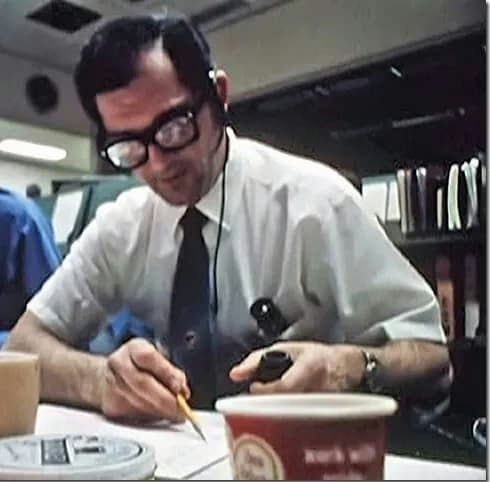
This was a monstrous decision. Years of planning. Billions of dollars. The dreams of a nation.
But Sy was trusted. He didn’t make the decision lightly — he agonized over it. But he acted. Flight Director Gene Kranz backed him immediately.
No second-guessing. No bureaucracy. Decisions were made by the people closest to the problem.
Later, another crisis hit:
The Lunar Module — meant to support two men for two days — now had to support three men for four days.
Carbon dioxide was building up. The filters were failing.
Death by asphyxiation was now the most likely outcome.
On the ground, engineers were given a seemingly impossible task: Build a CO₂ scrubber from junk available onboard.
Plastic bags. Duct tape. Cardboard. Socks.
They worked like an agile team — cross-functional, focused, urgent.
They improvised a device.
And then — in a triumph of fast, bottom-up problem solving — they talked the astronauts through building it.
It worked. They bought the crew precious days of breathable air.
The Real Lessons from Apollo 13
NASA didn’t save Apollo 13 because the boss made all the decisions.
NASA saved Apollo 13 because they had built a system where:
- Clear goals trumped egos (“Get them home alive.”)
- Ownership was pushed to the front line.
- Trust and preparation enabled decentralized action.
- Ordinary people, trusted with leadership, rose to extraordinary heights.
This wasn’t chaos.
It was a structured system of distributed leadership, designed to move fast and act smart in the most complex, unpredictable environment imaginable.
Today’s managers fear chaos if they loosen their grip. But the real chaos is slow, centralized decision making in a crisis.
When you trust your people — when you give them clear goals, true ownership, and the power to act — you don’t get recklessness.
You get responsibility. You get brilliance.
The Moral
Apollo 13 became known as NASA’s “successful failure.”
They failed to land on the moon — but they succeeded where it mattered most: saving lives.
It’s tempting to think “those were exceptional people.” They weren’t. They were regular engineers, scientists, flight controllers — ordinary people, in an extraordinary culture of trust and clarity.
What would happen if we trusted our people the same way — even before the crisis hits?